











The Coffin of Andy and Leyley gameplay video 1
Gameplay footage showing exploration, dialogue, character tension, and the oppressive apartment setting.
Play The Coffin of Andy and Leyley Online

Video
Gameplay footage showing exploration, dialogue, character tension, and the oppressive apartment setting.
Gameplay footage showing exploration, dialogue, character tension, and the oppressive apartment setting.
Home
Jump to the play area, read the introduction, and open the FAQ for this horror visual novel page.
Confinement makes cooperation necessary before either sibling can decide what a healthier relationship would require. In The Coffin of Andy and Leyley, Andrew and Ashley repeatedly face problems that would be frightening even without their shared history. Scarcity, locked spaces, violence, and uncertainty demand practical action, yet every solution also tests who may define the relationship. A quarantined apartment and the spaces beyond it feel emotionally smaller as food, escape, memory, violence, and family history keep returning to the same relationship. The horror grows when a temporary survival arrangement begins behaving like a permanent rule about loyalty, access, and responsibility.
Notice how physical limits are quickly translated into emotional permission. The player should read dialogue as a negotiation over boundaries, not only as exposition. A joke can reduce tension while dismissing refusal. A promise can offer comfort while creating debt. A quiet response can signal fear, calculation, resentment, or an attempt to avoid escalation. examining rooms, finding items, solving environmental obstacles, reading dialogue tone, and observing how choices shift responsibility between the siblings. Room exploration and object use matter because they show which person acts, which person directs, and which person is later expected to carry the moral explanation.
This Survive Min interpretation keeps emotional distance at the center. each emergency gives the pair another reason to remain together while making independence, honesty, and ordinary boundaries more difficult to recover. After an important scene, identify what each sibling was allowed to choose before and after the exchange. Follow one boundary from its first violation to its later consequence and compare who benefits each time it is redefined. That controlled replay reveals pressure more clearly than rushing toward a different ending, because it shows exactly when familiarity stopped functioning as understanding and began functioning as authority. It contains violence, death, coercive family dynamics, criminal behavior, cannibalism references, disturbing imagery, and mature psychological themes.
Withdrawal can look passive, but it often reveals an attempt to keep responsibility and identity from being completely absorbed by the pair. In The Coffin of Andy and Leyley, Andrew and Ashley repeatedly face problems that would be frightening even without their shared history. Scarcity, locked spaces, violence, and uncertainty demand practical action, yet every solution also tests who may define the relationship. A quarantined apartment and the spaces beyond it feel emotionally smaller as food, escape, memory, violence, and family history keep returning to the same relationship. The horror grows when a temporary survival arrangement begins behaving like a permanent rule about loyalty, access, and responsibility.
Read hesitation as information rather than treating it as empty delay. The player should read dialogue as a negotiation over boundaries, not only as exposition. A joke can reduce tension while dismissing refusal. A promise can offer comfort while creating debt. A quiet response can signal fear, calculation, resentment, or an attempt to avoid escalation. examining rooms, finding items, solving environmental obstacles, reading dialogue tone, and observing how choices shift responsibility between the siblings. Room exploration and object use matter because they show which person acts, which person directs, and which person is later expected to carry the moral explanation.
This Survive Min interpretation keeps emotional distance at the center. each emergency gives the pair another reason to remain together while making independence, honesty, and ordinary boundaries more difficult to recover. After an important scene, identify what each sibling was allowed to choose before and after the exchange. Follow one boundary from its first violation to its later consequence and compare who benefits each time it is redefined. That controlled replay reveals pressure more clearly than rushing toward a different ending, because it shows exactly when familiarity stopped functioning as understanding and began functioning as authority. It contains violence, death, coercive family dynamics, criminal behavior, cannibalism references, disturbing imagery, and mature psychological themes.
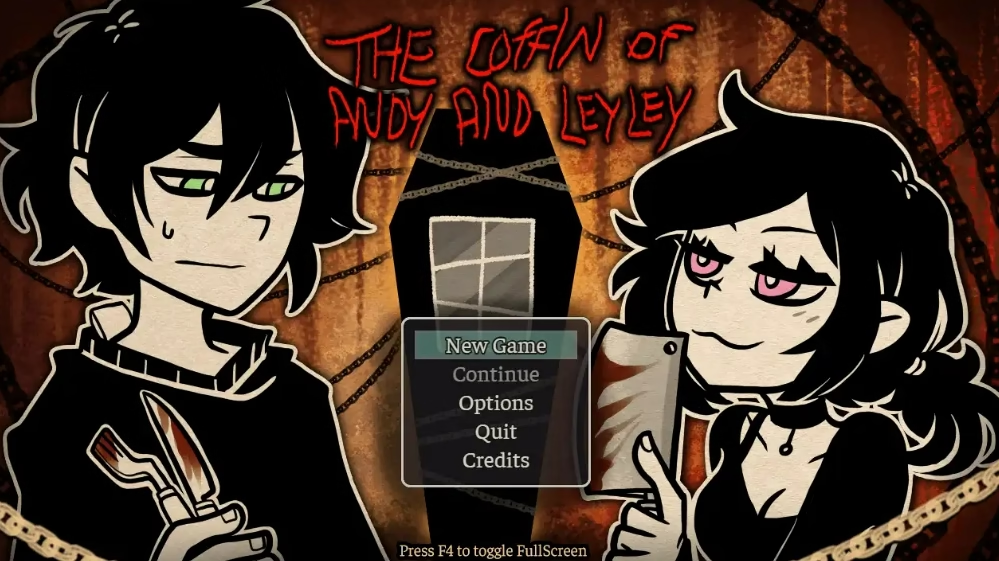
Confidence can solve immediate problems while also deciding what Andrew is expected to feel, remember, and accept. In The Coffin of Andy and Leyley, Andrew and Ashley repeatedly face problems that would be frightening even without their shared history. Scarcity, locked spaces, violence, and uncertainty demand practical action, yet every solution also tests who may define the relationship. A quarantined apartment and the spaces beyond it feel emotionally smaller as food, escape, memory, violence, and family history keep returning to the same relationship. The horror grows when a temporary survival arrangement begins behaving like a permanent rule about loyalty, access, and responsibility.
Compare the speed of her solution with the freedom left after it. The player should read dialogue as a negotiation over boundaries, not only as exposition. A joke can reduce tension while dismissing refusal. A promise can offer comfort while creating debt. A quiet response can signal fear, calculation, resentment, or an attempt to avoid escalation. examining rooms, finding items, solving environmental obstacles, reading dialogue tone, and observing how choices shift responsibility between the siblings. Room exploration and object use matter because they show which person acts, which person directs, and which person is later expected to carry the moral explanation.
This Survive Min interpretation keeps emotional distance at the center. each emergency gives the pair another reason to remain together while making independence, honesty, and ordinary boundaries more difficult to recover. After an important scene, identify what each sibling was allowed to choose before and after the exchange. Follow one boundary from its first violation to its later consequence and compare who benefits each time it is redefined. That controlled replay reveals pressure more clearly than rushing toward a different ending, because it shows exactly when familiarity stopped functioning as understanding and began functioning as authority. It contains violence, death, coercive family dynamics, criminal behavior, cannibalism references, disturbing imagery, and mature psychological themes.
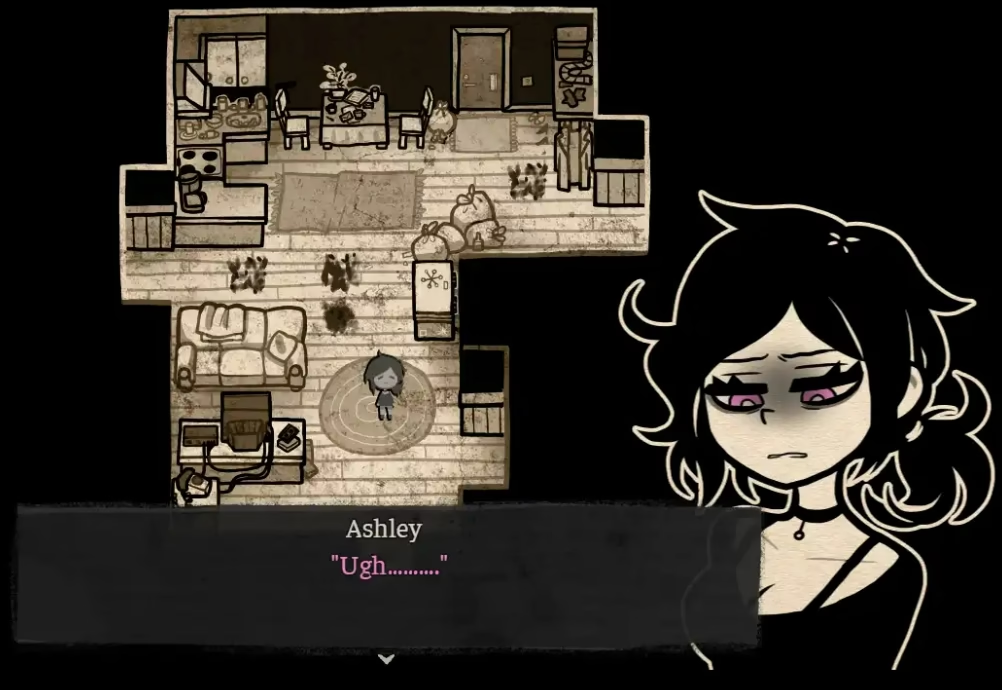
Once concealment becomes mutual, loyalty can be measured by willingness to protect the secret instead of care for the person. In The Coffin of Andy and Leyley, Andrew and Ashley repeatedly face problems that would be frightening even without their shared history. Scarcity, locked spaces, violence, and uncertainty demand practical action, yet every solution also tests who may define the relationship. A quarantined apartment and the spaces beyond it feel emotionally smaller as food, escape, memory, violence, and family history keep returning to the same relationship. The horror grows when a temporary survival arrangement begins behaving like a permanent rule about loyalty, access, and responsibility.
Track who benefits whenever silence is described as protection. The player should read dialogue as a negotiation over boundaries, not only as exposition. A joke can reduce tension while dismissing refusal. A promise can offer comfort while creating debt. A quiet response can signal fear, calculation, resentment, or an attempt to avoid escalation. examining rooms, finding items, solving environmental obstacles, reading dialogue tone, and observing how choices shift responsibility between the siblings. Room exploration and object use matter because they show which person acts, which person directs, and which person is later expected to carry the moral explanation.
This Survive Min interpretation keeps emotional distance at the center. each emergency gives the pair another reason to remain together while making independence, honesty, and ordinary boundaries more difficult to recover. After an important scene, identify what each sibling was allowed to choose before and after the exchange. Follow one boundary from its first violation to its later consequence and compare who benefits each time it is redefined. That controlled replay reveals pressure more clearly than rushing toward a different ending, because it shows exactly when familiarity stopped functioning as understanding and began functioning as authority. It contains violence, death, coercive family dynamics, criminal behavior, cannibalism references, disturbing imagery, and mature psychological themes.
Inventory is not only practical; carrying, finding, or using an object can make a character part of an act they did not define alone. In The Coffin of Andy and Leyley, Andrew and Ashley repeatedly face problems that would be frightening even without their shared history. Scarcity, locked spaces, violence, and uncertainty demand practical action, yet every solution also tests who may define the relationship. A quarantined apartment and the spaces beyond it feel emotionally smaller as food, escape, memory, violence, and family history keep returning to the same relationship. The horror grows when a temporary survival arrangement begins behaving like a permanent rule about loyalty, access, and responsibility.
Remember who selected the tool and who inherits its consequence. The player should read dialogue as a negotiation over boundaries, not only as exposition. A joke can reduce tension while dismissing refusal. A promise can offer comfort while creating debt. A quiet response can signal fear, calculation, resentment, or an attempt to avoid escalation. examining rooms, finding items, solving environmental obstacles, reading dialogue tone, and observing how choices shift responsibility between the siblings. Room exploration and object use matter because they show which person acts, which person directs, and which person is later expected to carry the moral explanation.
This Survive Min interpretation keeps emotional distance at the center. each emergency gives the pair another reason to remain together while making independence, honesty, and ordinary boundaries more difficult to recover. After an important scene, identify what each sibling was allowed to choose before and after the exchange. Follow one boundary from its first violation to its later consequence and compare who benefits each time it is redefined. That controlled replay reveals pressure more clearly than rushing toward a different ending, because it shows exactly when familiarity stopped functioning as understanding and began functioning as authority. It contains violence, death, coercive family dynamics, criminal behavior, cannibalism references, disturbing imagery, and mature psychological themes.
Old roles make current pressure sound familiar enough to escape scrutiny. In The Coffin of Andy and Leyley, Andrew and Ashley repeatedly face problems that would be frightening even without their shared history. Scarcity, locked spaces, violence, and uncertainty demand practical action, yet every solution also tests who may define the relationship. A quarantined apartment and the spaces beyond it feel emotionally smaller as food, escape, memory, violence, and family history keep returning to the same relationship. The horror grows when a temporary survival arrangement begins behaving like a permanent rule about loyalty, access, and responsibility.
Ask whether a childhood pattern explains behavior or is being used to excuse it. The player should read dialogue as a negotiation over boundaries, not only as exposition. A joke can reduce tension while dismissing refusal. A promise can offer comfort while creating debt. A quiet response can signal fear, calculation, resentment, or an attempt to avoid escalation. examining rooms, finding items, solving environmental obstacles, reading dialogue tone, and observing how choices shift responsibility between the siblings. Room exploration and object use matter because they show which person acts, which person directs, and which person is later expected to carry the moral explanation.
This Survive Min interpretation keeps emotional distance at the center. each emergency gives the pair another reason to remain together while making independence, honesty, and ordinary boundaries more difficult to recover. After an important scene, identify what each sibling was allowed to choose before and after the exchange. Follow one boundary from its first violation to its later consequence and compare who benefits each time it is redefined. That controlled replay reveals pressure more clearly than rushing toward a different ending, because it shows exactly when familiarity stopped functioning as understanding and began functioning as authority. It contains violence, death, coercive family dynamics, criminal behavior, cannibalism references, disturbing imagery, and mature psychological themes.
Later scenes often reveal that a dangerous rule entered the relationship much earlier than the visible crisis. In The Coffin of Andy and Leyley, Andrew and Ashley repeatedly face problems that would be frightening even without their shared history. Scarcity, locked spaces, violence, and uncertainty demand practical action, yet every solution also tests who may define the relationship. A quarantined apartment and the spaces beyond it feel emotionally smaller as food, escape, memory, violence, and family history keep returning to the same relationship. The horror grows when a temporary survival arrangement begins behaving like a permanent rule about loyalty, access, and responsibility.
Follow one promise or accusation instead of changing every choice. The player should read dialogue as a negotiation over boundaries, not only as exposition. A joke can reduce tension while dismissing refusal. A promise can offer comfort while creating debt. A quiet response can signal fear, calculation, resentment, or an attempt to avoid escalation. examining rooms, finding items, solving environmental obstacles, reading dialogue tone, and observing how choices shift responsibility between the siblings. Room exploration and object use matter because they show which person acts, which person directs, and which person is later expected to carry the moral explanation.
This Survive Min interpretation keeps emotional distance at the center. each emergency gives the pair another reason to remain together while making independence, honesty, and ordinary boundaries more difficult to recover. After an important scene, identify what each sibling was allowed to choose before and after the exchange. Follow one boundary from its first violation to its later consequence and compare who benefits each time it is redefined. That controlled replay reveals pressure more clearly than rushing toward a different ending, because it shows exactly when familiarity stopped functioning as understanding and began functioning as authority. It contains violence, death, coercive family dynamics, criminal behavior, cannibalism references, disturbing imagery, and mature psychological themes.
Long sessions, oppressive audio, disturbing themes, and repeated dialogue can weaken careful interpretation. In The Coffin of Andy and Leyley, Andrew and Ashley repeatedly face problems that would be frightening even without their shared history. Scarcity, locked spaces, violence, and uncertainty demand practical action, yet every solution also tests who may define the relationship. A quarantined apartment and the spaces beyond it feel emotionally smaller as food, escape, memory, violence, and family history keep returning to the same relationship. The horror grows when a temporary survival arrangement begins behaving like a permanent rule about loyalty, access, and responsibility.
Use fullscreen for details but take breaks before discomfort becomes numbness. The player should read dialogue as a negotiation over boundaries, not only as exposition. A joke can reduce tension while dismissing refusal. A promise can offer comfort while creating debt. A quiet response can signal fear, calculation, resentment, or an attempt to avoid escalation. examining rooms, finding items, solving environmental obstacles, reading dialogue tone, and observing how choices shift responsibility between the siblings. Room exploration and object use matter because they show which person acts, which person directs, and which person is later expected to carry the moral explanation.
This Survive Min interpretation keeps emotional distance at the center. each emergency gives the pair another reason to remain together while making independence, honesty, and ordinary boundaries more difficult to recover. After an important scene, identify what each sibling was allowed to choose before and after the exchange. Follow one boundary from its first violation to its later consequence and compare who benefits each time it is redefined. That controlled replay reveals pressure more clearly than rushing toward a different ending, because it shows exactly when familiarity stopped functioning as understanding and began functioning as authority. It contains violence, death, coercive family dynamics, criminal behavior, cannibalism references, disturbing imagery, and mature psychological themes.
→The Coffin of Andy and Leyley is a claustrophobic psychological horror adventure about Andrew and Ashley, siblings whose survival partnership keeps turning care, fear, obligation, and control into the same language.
→Yes. Use the embedded browser player above without installing a separate application first.
→The experience combines room exploration, object collection, environmental problems, dialogue, and story choices.
→The siblings often use survival, history, and loyalty to decide what the other person should accept, making personal limits central to the horror.
→Follow one promise, accusation, refusal, or practical decision across the route and compare how its meaning changes.
→A modern mobile browser may work, but desktop fullscreen makes room details and dialogue easier to follow.
→Wait for remote assets, click inside the frame, refresh once, and check blockers or network filters.
→Progress may depend on local browser storage, so private mode, clearing data, or changing profiles can remove it.
→No. It contains violence, death, coercive family dynamics, criminal behavior, cannibalism references, disturbing imagery, and mature psychological themes.